What will communication be 50 years from now?

by: Joshua Pionelo & Rica Mae Quidato

Through the years, communication has evolved significantly. The whole system of communication has been revamped tremendously through the incorporation of technology. The way we communicate is entirely different from ancient times. Previously, conveying is constrained to relational collaboration – individual to individual. Until it advanced to alphabets, signs and images, letters, and phone. Today, the Internet era has paved the way to innumerable means of communication.

Innovation has in fact reclassified correspondence. Individuals never again need to hang tight for quite a long time, months, weeks, and days to get data or message. Today, writings, messages, tweets, and individual messages can arrive at the beneficiary in merely a question of seconds.

928-300x336
telepathic communication. [Online image].  Retrieved August 28, 2019 from http://operationmeditation.com/discover/telepathic-communication-nine-questions-answered/

In the distant future, we may be able to communicate by sending our thoughts through a network directly into someone else’s brain (Strickland, 2010). Bio implants or technologies embedded in our body for communication might become also a reality in the future for bio-implants have been used for indicators for our body in the medical field (Teshome and Kibret, 2018).

digital-age-face-to-face-communciation
digital age face – to – face communication. [Online image].  Retrieved August 24, 2019 from https://blog.ferrovial.com/en/2017/02/disappearance-of-face-to-face-conversation/

Unfortunately, the advancement of communication through the assistance of technology is not all rainbow and sunshine. Along with the innovation of long-distance communication is the pervasive shyness that developed within us. “Technology has made us shy away from face to face conversation” and this has extremely negative consequences, because “conversation is the basis of democracy and business, it supports empathy and is essential for friendship, love, learning, and productivity” (Salgado, 2017).

In no time, everything around us will be changed dramatically and these changes will be unnoticeable. We will just be realizing it one day that though the way we live our lives every day has become easier, the time we spend on new technology and social media is immensely increasing thus creating less time for real-life interactions (Eastman, 2013). As these kinds of lifestyle will grow, verbal and face to face communication will be nearly forgotten and become a mere trend in the past.

References

Kaul, V. (2012). The Changing World of Media & Communication. Journal of Mass Communication and Journalism, 2:116. doi:10.4172/2165-7912.1000116

Stricklan, J. (2010, April 12). What is the future of communication?. Retrieved from https://electronics.howstuffworks.com/everyday-tech/future-of-communication1.htm

Salgado, A. (2017, February 28). so easy, yet so difficult… the disappearance of face to face conversation. Retrieved August 24, 2019, from https://blog.ferrovial.com/en/2017/02/disappearance-of-face-to-face-conversation/

Teshome, A. K., Kibret, B., & Lai, D. T. (2018). Wireless Implant Communications Using the Human Body. In M. Khosrow-Pour, D.B.A. (Ed.), Encyclopedia of Information Science and Technology, Fourth Edition (pp. 6319-6334). Hershey, PA: IGI Global. doi:10.4018/978-1-5225-2255-3.ch550


Artificial Intelligence; Better or Worst?

Communication and Media in 50 years

Ma. Luz Villegas, Nancy Sandig
https://www.forbes.com/sites/bernardmarr/2019/05/07/artificial-intelligence-is-creating-a-fake-world-what-does-that-mean-for-humans/#7cfa4cda32bf

A cliche statement would say, “There’s nothing constant in this world except change”.

A point with loop holes and possibilities on it, what change? A step for better or for worse? We’re living now in a global village where gathering and disseminating of information factual or either way depend in just a flick of a finger.

At present, personal connections, elitists, politicians and threats of fabrications rotten the credibility of information, and media avenues. What more after five decades? Let’s pave backwards, to those times where media and communication were unconventional and requires time under a simple letter courier – telegram. Early radios and television covers only small scale of population. Information before travels in every corner of the world in a span of weeks or months.

It is way far from today, where internet signals are ubiquitous. The media avenues are escalating and the virtual world for communication are getting more active compared to past years. It is a big no when l say that media convergence has no benefits.

After 5 decades, media will be ran by artificial intelligences and communication through super modern technologies, talking to a real-time holograms and internet connection of  1000 mbps. Disseminating of information will be faster but face to face conversation and social gatherings will drop real low.

Picture on the left: https://yourstory.com/mystory/the-future-artificial-intelligence-in-the-service–iakc2yo6a2

Picture on the right: https://www.pond5.com/stock-footage/90876783/person-projection-futuristic-holographic-display-tablet-holo.html

Technology will make everything easier and faster. We can’t stop humans from discovering things that pushes life to its tipping point but also, we should not be contented on looking back and live on the discoveries of yesterday. but it is our responsibility to learn disconnecting virtually and strengthen bonds in reality. 

A Filipino Heart

By: Arianne Pagador & Hazel Mae Pagal

58800438_357124354922224_462512572701081600_n (1).jpg

58719948_421511848633742_395914582176038912_n


The closest Filipino word for social competency is pakikipagkapwa. According to Guevarra (2005), pakikipagkapwa recognizes the otherness in another person and triumphs over egocentrism. Relationships that are social in nature for the Filipinos are considered ethical since ethical decisions are based on social relations. Empathizing is impossible if Filipinos are egotists because it would be very difficult to understand how it is to be in another person’s shoes. In pakikipagkapwa, it is a requirement to let go of egotism to be able to recognize the otherness of the other. In the same light, Marcelino (1990) acknowledged that pakikipagkapwa is psychologically and philosophically very important. As a paninindigan (conviction), it is a value with moral and normative aspect which makes its implications more profound and deeper.

In pakikipagkapwa, one needs to deal and accept another person with respect, dignity, and with equality (Calaguas, 2012). In addition, there is a sense of openness and feeling of one with another among Filipinos. Others are regarded with dignity and respect and are dealt as fellow human beings.

Pakikipagkapwa-tao is manifested by having a sense of justice and fairness, and concern for others. Empathy to others is demonstrated by being helpful and being generous in times of need (pakikiramay), by practicing mutual assistance (bayanihan), and being hospitable (Filipino hospitality). Sensitivity to how others feel (pakikiramdam), trust (pagtitiwala), and recognition of gratitude (utang-na-loob) are equally very evident among Filipinos. Sensitivity to the quality and dependence on interpersonal relationships is brought about by pakikipagkapwa-tao (Licuanan, 1994). Moreover, caring is very compatible with the different levels of the relational value system of pakikipagkapwa-tao. The caring for family members, as well as with neighbors and friends (taga-atin), and others is very evident among Filipinos. The concept of one’s self is completely the opposite of the Western concept (specifically the value given by Americans to personal liberties) in the sense that it is not autonomous. Asking and knowing what is happening to others (pakialam) is a way of showing concern. Being a member means may pakialam (Manauat, 2005).

Related Literature:
Calaguas, G. 2012. Investigating Social Competency in the Filipino Context. Retrieved
April 29, 2019 from https://www.questia.com/library/journal/1P3-3019546771/investigating-social-compe tency-in-the-filipino-context.

Hospitality and Fatality

Hospitality is a trait inculcated in Filipinos since the pre-colonial times which is still inherited by the recent generations. Some parts in our history show that we were welcoming towards the Spanish invaders. It can be argued that our hospitality is one of the reason why they easily colonized us.

Part of the Filipino culture is to always treat our guests warmly, whether they are foreigners or not. Therefore if there is one thing that foreigners would usually comment about right after they visit the Philippines, it would probably not be the food or the places they visited, but the hospitality of the people. Since we were young, we noticed everytime when we have a visitors in our home, our moms tend to show off the fancy plates, curtains, and other objects stocked and displayed in the cabinet for years already. This trait of Filipinos was sometimes be called as “pakitang tao”, like we do not want to be underestimated by other people even though we, working Filipinos are pushing blood and sweat to earn money.

___________________________________________________________________________________________

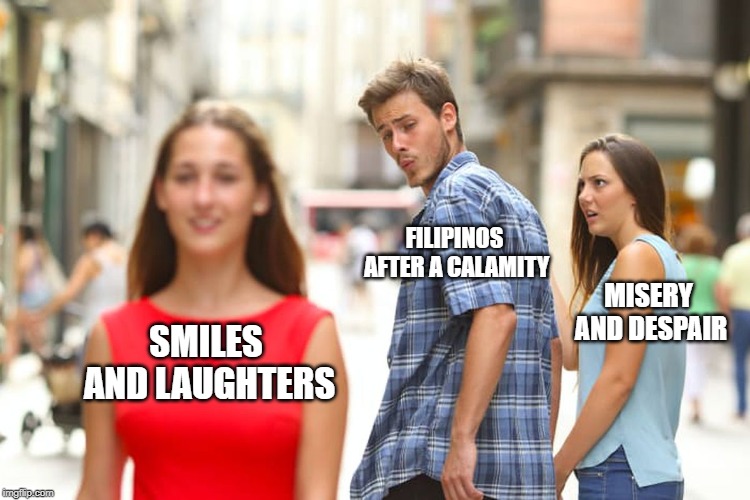
If the Japanese are disciplined during disasters, then the Filipinos are happy go-lucky. We have proven it so many times in the face of disasters, especially with floods as the Philippines happens to be a typhoon magnet. Even though our homes are flooded and our properties are destroyed, we will just smile away and laugh (and make countless memes). By extension, we smile and laugh at our personal, social, and economic troubles.

Just how do Filipinos in general cope up with life’s problems? The answer lies of course in the national psyche, known as the “Bahala na” or fatalistic attitude. Filipino fatalism can be double-edged; while it resigns a Filipino to his fate, it also gives him the strength to endure.

In cases of troubles and disasters, “optimistic fatalism” gives Filipinos the resiliency they need to survive in the belief that such problems will eventually go away. And as we have seen, this good kind of “Bahala Na” has served Filipinos well countless times already.


Submitted by:

Nicole Pauline Plagata

Ma. Lorena Serisola


Unveiling Filipino Identity through memes

https://www.asianjournal.com/magazines/unboxing-filipino-culture-close-family-ties-/


              One of the distinctive traits of Filipinos is their strong family ties. Family is their topmost priority which influences their ideas, values, and aspirations in life. They value their family by following good values such as being respectful to elders is the “ po and opo”. Also, they give importance to special occasions like Christmas, birthdays and New Year by spending it together with their families. Their family is considered as their primary support system that offers love, comfort, and positivity during dilemmas. In decision-making and career, they have to consider their family’s views and suggestions first. Even after marriage, they still live within one roof with their parents.


received_1056745201200012

https://www.rappler.com/move-ph/10188-filipino-humor-persists-in-times-of-disaster


             You know you’re in the Philippines when people always have a smile on their faces even at the worst of times. Filipinos are always associated with this for it is said to be a unique defense mechanism to cope with all the problems heading their way. Not delving too much on situations or things that are out of control is one of the many positive traits that Filipinos have within. Also, it can be explained by how these people have a strong religious faith that makes them stronger, for there is someone out there, The Most High, that will help them through the storms and see rainbows thereafter.


SUBMITTED BY: ALAR, NOREEN BEAH M.

BALAD-ON, NICOLE K.


NOTHING BEATS A COMPLIMENT WHEN ASKING FOR A FAVOR

2nd

“Filipinos are modest in nature.”

As Filipinos we are known to be humble regarding our good looks, new outfits and even our talents. But we can’t do away with the fact that we love hearing and taking compliments from other people. We Filipinos are known to have keen eyes, we are very observing when there are some changes that take part in the life of our fellow Filipino and if he or she wore something different from his or her usual get up.

Our modesty then is one thing that other people use against us and towards their own advantage. Since they know that we love being praised, they would always say that we look good on this and that. The reason for this is because they know that it will be hard for to decline the favour that they are asking for if they have already hit your soft spot. Your views and opinion towards that person will now change and almost everything he or she will ask you, you will give in. Even though we know that they’re just using us for the mere fact that we have something that they want, we tend to be oblivious. Why? Simply because deep within us we wanted to hear those compliments but since we are too modest, we don’t want to say it ourselves because we also fear being labelled as narcissist.

FILIPINOS AS “BALAT SIBUYAS”

balat sibuyas.jpg

It’s perfectly normal to us, Filipinos, to criticize and taunt others, but when it’s being hurled back at us, we either can’t handle it with a straight face, or we pretend it didn’t hurt. Showcasing how we are extra sensitive to insults directed to us.

“Filipinos are sensitive to attacks on their own self-esteem and cultivate a sensitivity to the self-esteem of others as well”. One factor that could trigger a friendship or a relationship to end is when you tried attacking ones self-esteem, so this better be avoided if you don’t want to sever your relationship with the other party. One great sanction against improper behaviour is a sense of shame and embarrassment but if that certain person lacks that he’s bound to do things against the other that could hurt their feelings since he or she thought that their fine with it therefore other people might feel the same way, that’s the reason why they become insensitive towards other people’s feelings. According to a drama we’re currently watching, self-appreciation is something that could boost one’s self esteem but if it’s a little too much that you end up belittling others then there’s nothing good with it at all. There’s one concept in the philosophy of Friedrich Nietzsche known as “Übermensch” which means “beyond-man or “over-man”, one example of this is that if you love yourself as it is and think positively, then even without thinking of using a friend to better yourself, you can overcome your boundaries and become someone amazing. You don’t need to risk severing your ties with other people just to climb up the ladder or be one step ahead of them. What good would it be, if you’re on top of the pyramid but no one’s there to celebrate your success with you?

by: Artuz & Sanchez

Memes: Mirror of Culture

spinach

Filipinos as an agricultural country never forget to plant something on their gardens. Typical Filipino families would cultivate agricultural crops or even ornamental plants so that, they will no longer buy, in case they need it. In fact, they are not only promoting a healthy environment but also allow them to save on some expenses. This is very true to people living in rural areas wherein you can just ask from your neighbours for some herbs and ingredients. Compared to high end cities where everything has an attached price tag, Filipinos do share the fruit of their labor in exchange of smiles and big thank you.

“Pag may tinanim, may aanihin”. Well, it only takes some effort to cultivate the soil and plant the seeds so that at the end of time, you will be enjoying good harvest. Vegetables are nutritious and is not restricted to any kind of diet. Having a bountiful supply from your own garden kcan prevent malnutrition among the family members. Watering the plants each day is also a good form of exercise. Philippines has a very hardworking citizens that don’t tend to get tires as long as they don’t see that everything’s fine. They are not cheap. Gardening a form of investment. It’s a time deposit for you to gain more profit.

kainIt’s a shame for those people who believe that accepting something from that people make them feel indebted. Filipino are naturally generous and often tend to share what they have received. The best example of this is by having a feast or parties and take outs are usually part of those occasion. This is a an admirable practice of giving what is more than enpugh as well strengthening our bond with our friends and relatives. It’s a social interaction that connects one Filipino family to another.

In fact, you will only receive take outs if you are a valued guest of the host. It’s a thoughtful approach so that when you reach your home, you will have something to share with your family. It’s not beggarly attitude as misinterpreted by those outside the community. It’s more like becoming a regular practice. Further, this also highlights the sense of practicality for both sides. The hosts will not be wasting excess food due to spoilage and the guest will save some cash for their next meal.

meme

Photos courtesy of :

Chapman J (2011): 250,000 elderly people who’ll be spending their Christmas alone. Available: http://www.dailymail.co.uk/news/article-2078261/250-000-elderly-people-ll-spending-Christmas-alone.html#ixzz2FXDlyfWT

Do Battad (2001): Make it Davao, Pagmamano Avalble at:http://davaocitybybattad.blogspot.com/2011/12/christmas-filipino-way.html

Filipino’s are family oriented. Almost all Filipino families is a nuclear family. A look inside a Filipino family and you can see the different branches of the family from the grandparents to the adults together with their family and sometimes even the family of their children’s uncles and aunt all live in the same roof. Even when a person grows and become adult, have a great job and a family, Filipinos always want to stay close with their parents. Unlike other countries especially in the west, where most of the time grandparents are left in homes for the aged and the responsibilities of the parent and children to each other are broken, Filipinos always find time to visit their grandparents and have a joyous moment with them. They even let their children grow together with them if they are working. Filipinos are concern about the keeping strong family ties with each other.


Created by :

Potato

Rasgo

Sante

Memes on Filipino Identity

59295110_587078178444411_343357101734625280_n.png

Filipinos with their Big Hearts

   What could it be that Filipinos can brag about the Philippines? It is very difficult to figure out particularly when the nation battles with an image issue (Thank you Mr. President): corruption, excessive war on drugs and others. These are portions of the general impressions of the world about the Philippines that, while undesirable, are unquestionably valid.

    In any case, in spite of the many negative remarks that regularly dominate the positives, there are certainly a large number of things to be pleased with. Head of which is really: ourselves. Filipinos are famous everywhere throughout the world for their amazing characteristics, regularly minimized or neglected, yet which in any case conveys pride to the nation.

   Basically, we Filipinos can be glad for our hospitality. We are exceptionally social individuals, capable in emotionally and socially associating with others.

   Our intrinsic hospitality is particularly clear in the minding ways we associate with those near us including others outside our kinfolk circle. Indeed, this attribute is one of the distinct assets of a large number of Filipino medical professionals, like care givers and caretakers who work abroad. For the most part, we are known for our genuine concern, and caring spirit which normally make our laborers sought after abroad. In spite of the fact that it might once in a while annoy us that our nation is frequently related with labor abroad(particularly DH), we can generally take a gander at it in a progressively positive view. We can stand proud with those Filipino specialists who give excellent and certified consideration to the remainder of the world.

   Our characteristic humility is additionally reflected in our renowned friendliness that genuinely stuns any individual who has encountered it. Outsiders who come to visit the Philippines speak of Filipinos making a special effort to help them when lost, or the endearing liberality of a Filipino family facilitating a guest in his. Additionally, most outsiders who go to Filipino social affairs abroad vouch for the glow and kind disposition of Filipinos as they experience that feeling of “belongingness.” Indeed, the unbelievable Filipino hospitality isn’t restricted to the Philippines. It is wherever there are Filipinos.

  Our inherent humility is maybe best exemplified in our empathy for other people. The sort of empathy that, feels compassion, speaks to the conscience to give assistance and soothe the enduring of others. Our empathy is prominently reflected in our own ability to help others.


58629872_643404212751480_7104522600809758720_n.png

The Funny and Real relationship of Vicks Vapor Rub and Filipino Moms

   They say you are not a Filipino if you don’t know Vicks Vapor Rub. Funny as it seems but it is believed that it can remedy a lot of common physical problems. It can relieve headache, fade bruises, prevent acne, treat wounds, soothe all kinds of muscle pains (yes, this includes the ears, and all 4 of our limbs), treat eczema, remove toenail fungus, remove warts, prevent infections and many more. It can be considered as a mother’s trusty sidekick.

   This relation with Vicks Vapor Rub perhaps stemmed from our fascination on herbal products. Having a big population consisting of mainly low-middle class to very low income earners, Philippine health-care mostly consists of home remedies and traditional healers. These healers are not as majestic as honorable babaylans, but they get the job done using knowledge about human anatomy (bones and muscles) and herbal concoctions. These skills and knowledge are passed down generation to generation from an elder to a chosen young disciple of the same family. Now this strong belief of effective unorthodox healing resulted to parents heavily relying on menthol ointments that have very striking similarities to the herbal products they once knew.

   This is not to make fun of our Filipino moms. This is to pay our deep respects to all hard-working mothers of the Philippines.

   In the event that you have such a great amount of bills to pay and kids to put in school, setting aside extra cash would be your main need. That implies you don’t purchase new garments until your old ones are so meager, they break. Or you don’t purchase costly sustenance and depend on tuyo, instant noodles, bagoong and other cheap Filipino nourishment to fill your stomach.

   Filipino moms know their need and that is to give their kids legitimate education, so they do every one of the things to set aside extra cash. That implies even not heading off to the medical clinic on the off chance that they realize they can fix it at home. In the event that you experienced childhood in a poor family, you know how costly a medical checkup can be. So as to set aside extra cash, they avoid the specialist and fix the messes with themselves. For Filipino mothers, it is something their parents did, and their grandparents did, so why won’t it be effective?


By: Duke Monsale and Miguel Mijares